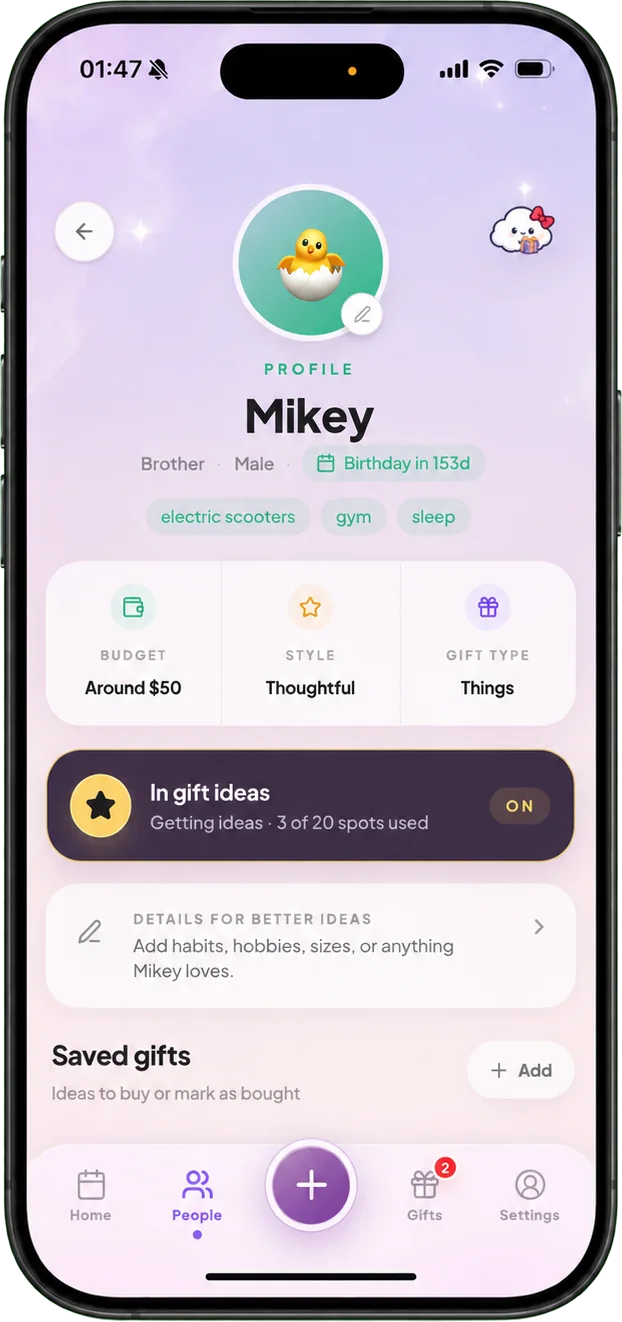
A useful gift profile keeps only the details that could change what you buy: what they are into right now, things they have mentioned wanting, what they already own, what to avoid, practical details when they matter, past gifts, and the random clue that would otherwise vanish before the next birthday.
You probably know a lot about the people you buy for. Most of it is just not in your head in a form that helps when you suddenly need to choose something.
Knowing that your sister likes green, your dad drinks coffee and your friend travels a lot may all be true. None of those facts gets you to a good gift on its own. Writing a few of them down means you do not start from zero every time their birthday comes around.
What belongs in a useful gift profile?
One test does most of the work:
Would this detail change what I might buy?
If yes, it may be worth keeping. If not, it is probably trivia.
Each one can rule something in or rule something out.
1. Current interests, not permanent labels
“Likes cooking” is broad enough to produce almost anything. “Has started making pizza every Friday and keeps complaining that the cheap cutter bends” gives you a direction.
Someone may have been obsessed with running three years ago and barely run now. The profile should describe the person you are buying for today. Useful notes tend to be specific:
- started learning pottery this spring
- takes the train to another city twice a month
- has got seriously into houseplants
- keeps borrowing a portable charger
- has been trying to make better coffee at home
Specific does not mean invasive. It just means useful enough to narrow the decision.
2. Things they have actually mentioned wanting
Direct clues deserve more weight than clever guesses. If somebody says “I really want to try one of those pottery classes,” that is your gift idea. You do not need something more surprising.
Save the clue while it is fresh, with enough context that it still makes sense six months later. A raw link or “the green one” can be almost as useless as no note at all.
pottery class
Sarah said she has wanted to try pottery for ages.
Check whether she booked one herself before her birthday.
That last part matters because clues go stale.
3. Things they already own
A second box of their favourite chocolates is probably fine. A second copy of the same book, another milk frother or duplicate hobby equipment may not be. You do not need an inventory of their home. Save ownership when it affects a category you are likely to buy from.
4. Things to avoid
Sometimes this is more useful than another list of likes.
A gift can be objectively nice and still be wrong because it creates storage, maintenance, sizing or scheduling work the recipient never asked for.
5. Practical details, only when they matter
Gift questionnaires often ask for sizes, favourite colours and favourite stores. Those can help, but not for everyone. Do not collect a shoe size because a checklist told you to. Save it if you actually buy shoes or slippers for this person. The same goes for clothing size, delivery constraints, food preferences, device or platform, preferred shops and favourite colours.
Every extra field is one more thing that can go out of date.
6. Past gifts
The minimum useful history is what you gave, for which occasion or year, and one outcome note if you genuinely know it.
Cedar candle, birthday 2025. She finished it and later asked where it came from.
That is more useful next year than “candle.” Past gifts are not only there to stop duplicates. They show which categories worked and whether an intentional repeat could make sense.
Some details expire faster than others
A profile should not turn into an archive of stale clues. It helps to think in two groups.
- birthday
- relationship
- major dislikes
- long-term interests
- previous gifts
- “wants AirPods”
- current clothing size
- a new hobby obsession
- this year’s wishlist item
- something they said they would buy themselves
A clue can be accurate in March and useless by Christmas. When you save something time-sensitive, add enough context to remember it needs checking:
Wants a new gym bag. Mentioned in February. Check whether she replaced it before buying.
That one sentence beats a six-month-old shopping link.
The best clues are often oddly specific
Dad likes coffee.
Dad makes coffee before anyone else wakes up and complains that his grinder is ridiculously loud.
Sarah likes travel.
Sarah does a three-hour train journey twice a month and her phone is nearly dead by the time she arrives.
The first version of each produces hundreds of generic products. The second gives you real directions: quieter equipment, a different brewing setup, better beans, a decent power bank. Specificity does not reveal “the perfect gift.” It gives you a better starting point, and that is enough.
What not to put in a gift profile
More information is not automatically better. You can skip:
- vague demographic stereotypes
- facts that cannot affect a gift decision
- old interests you have not seen them care about for years
- every product link you have ever considered
- sensitive information that has no gifting purpose
- casual comments you are treating as permanent preferences
“Woman, 28, likes travel” is not useful because it is generic. A hundred fields about one person are not useful because nobody will maintain them. Keep a few notes you will understand when the birthday comes around.
A 60-second gift profile template
Copy this into Notes, a spreadsheet, a contact note or a gift-planning app.
- Name:
- Important dates:
- Right now they’re into:
- They’ve mentioned wanting:
- They already have:
- Avoid:
- Useful practical detail:
- Past gifts:
- Random clue worth remembering:
- Anything to re-check before buying:
You do not need to fill every field. One person might have four lines, another ten. Empty fields are better than invented information.
You do not need to interview people to build one
A formal preference questionnaire can be perfect for Secret Santa or a family that openly shares wishlists. Most personal profiles get built more quietly.
- They say they want to try pottery. Save it.
- They complain about something they use every week. Save the reason.
- They use your last gift constantly. Add that to the history.
- They say they never want another scented candle. Definitely save that.
The useful information already shows up in normal life. The hard part is remembering it six months later.
Where Giftin fits
Giftin keeps dates, notes, saved ideas and past gifts with each person. You choose when the early and final reminders arrive, and whether one comes on the day. When you ask for gift ideas, it can use what you saved and which suggestions you liked or skipped. See how Giftin finds ideas.
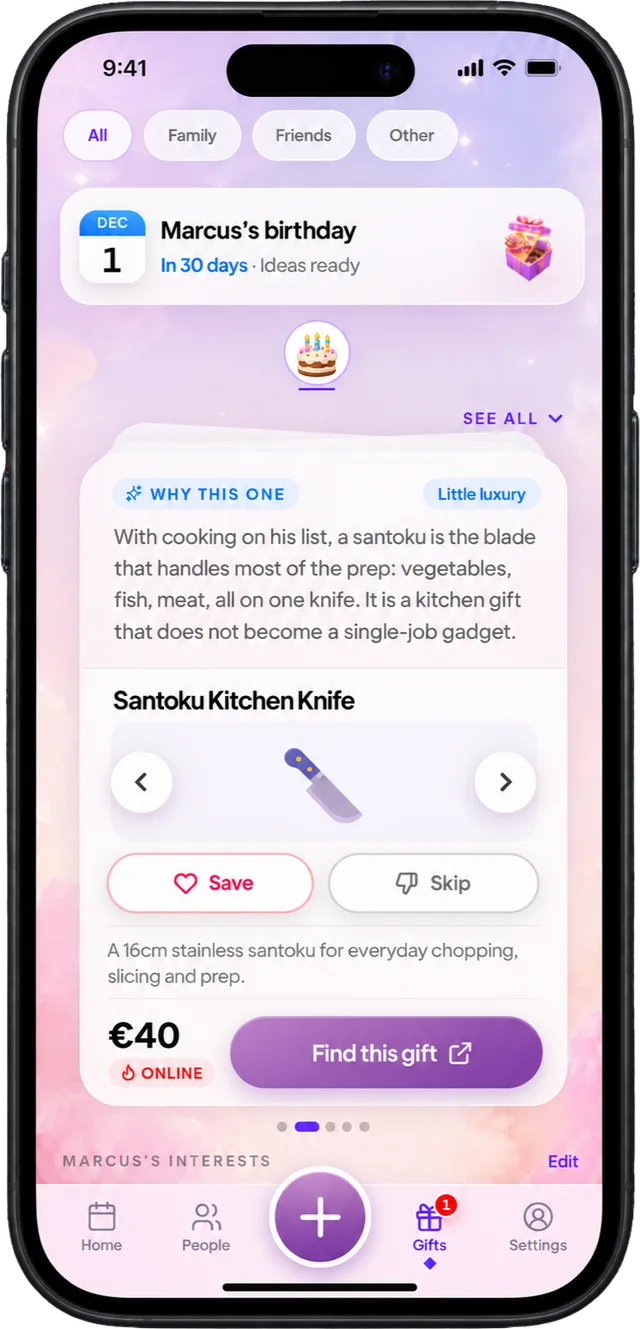
Not every person needs a detailed profile. Just keep the few things you already know that help you choose better. When you are ready to decide, here is how to choose the gift itself.

Keep the details that matter.
Giftin keeps interests, things to avoid, saved ideas and past gifts on the person, ready for the next occasion.
Download Giftin