Giftin starts with what you saved about someone: what they like, what you have already given them, your budget and the occasion. It suggests a few different ideas and tells you why each might fit. You choose what feels right.
Why did Giftin suggest a cow-themed blanket instead of five pieces of cow merchandise?
Because one interest should not take over every suggestion, and squeezing every detail into one product rarely works. Giftin is built to use different parts of the person for different ideas, then explain why each one may fit.
Start with clues that can change the gift
Depending on what you add, Giftin can consider the person’s first name, your relationship, age range, interests, preferences, style, budget, occasion, time remaining, location, notes, past gifts and your response to earlier ideas.
Location works as its own clue. When you share a city or region, Giftin can suggest local shops and experiences instead of defaulting to the same online products everywhere, and it points shopping links at the right regional store. You can type a city yourself instead of sharing device location, and ideas still work without it.
You do not need to complete every field. More information is only helpful when it would change what you buy. “Recently moved into a small flat” can matter. A full legal identity, diagnosis, financial detail or private secret does not belong in a gift-planning request.
The same person should not get the same answer every time
A gift can suit the person and still be wrong for the moment. A playful birthday idea may feel strange at a retirement. A wedding may require thinking about a couple. A housewarming gift has to fit a new home, which may be small.
Time changes the answer too. A custom item is not a good suggestion if it cannot arrive. When the occasion is close, the ideas need to work within the time that remains.
One loud interest should not own the list
Giftin is designed to show different kinds of options rather than five versions of the first obvious hobby. One suggestion may follow a strong interest. Another may focus on comfort, routine, style, an experience or the relationship.
Variety does not mean random products. Every idea still needs a clear reason to connect to the person.
The cow blanket example
For one example, imagine someone who likes cats, medicine, sleeping and cows.
- 26 years old
- likes cats and cows
- interested in medicine
- loves sleeping
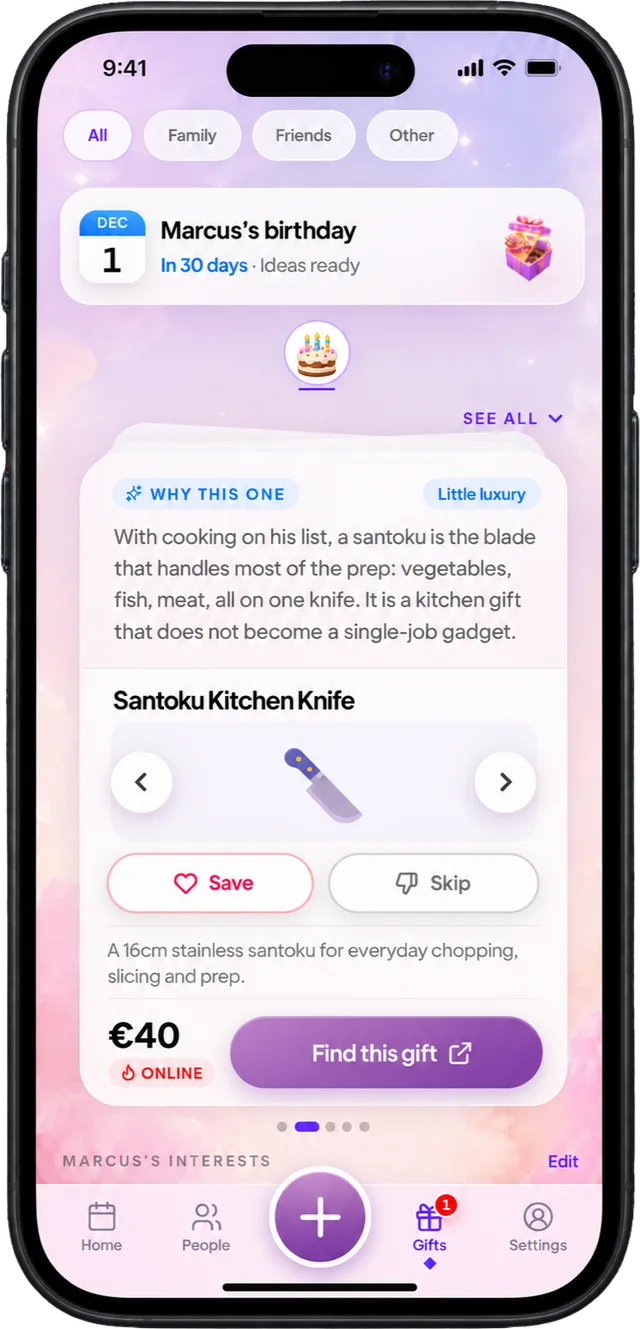
Cows supplied the theme. Sleeping supplied the purpose. Cats and medicine could lead to other ideas instead of being forced onto the same object.
Past ideas stop every occasion from starting at zero
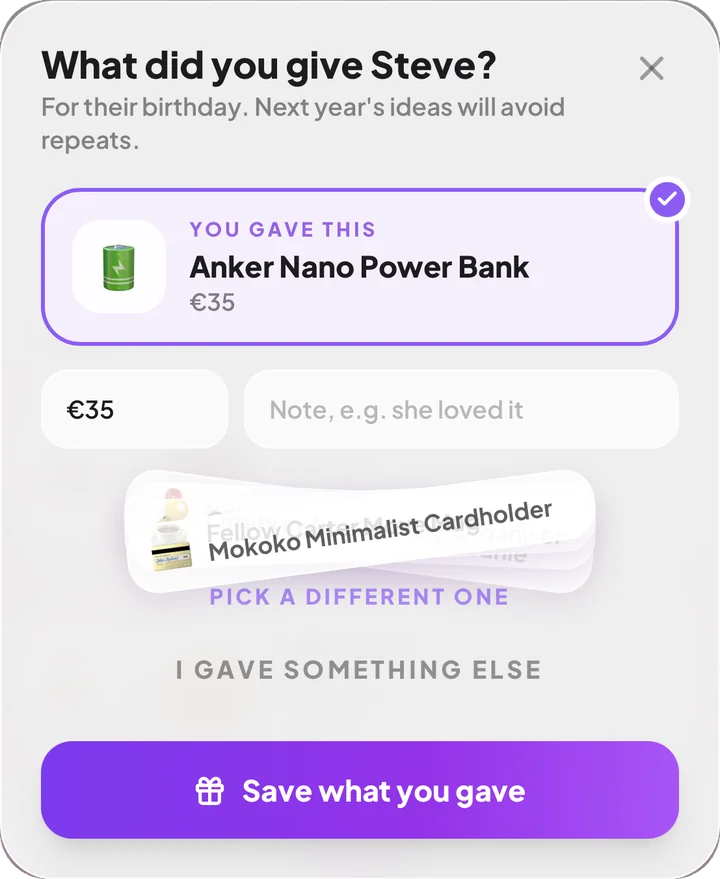
Giftin can use saved ideas, ideas marked “not for them” and gifts already given to reduce repetition. When you ask for more ideas, the next set should go in a new direction instead of showing the same product again.
 Log what you gave
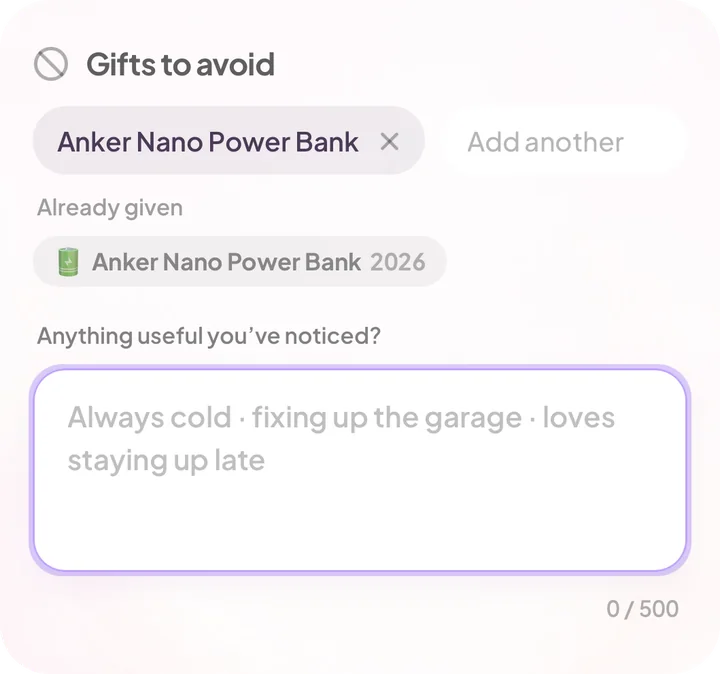 It becomes something to avoid
Your response also supplies information that a profile cannot. Skipping an idea may reveal that a category, style or level of intimacy is wrong even when the recipient’s interests looked relevant.
What happens before the ideas appear?
Here is what happens between the notes you save and the gift ideas you see.
- interests and routines
- relationship and occasion
- budget and time left
- city, if you gave one
- what you already gave
- one idea from a strong interest
- one from comfort or routine
- one from an experience
- one from the relationship
- look for repeats
- check whether the details fit
- check the seller and location
- check price and availability
- a few ideas, not a hundred
- a reason attached to each
- a link that goes to a real search
Saving an idea or marking it "not for them" feeds back into stage one, so the next set can go somewhere new.
Giftin uses the information you save to look for ideas that fit the person and tries to avoid obvious repeats. Check the suggested item, seller, location and availability before buying.
Personal ideas do not require a complete personal profile
Use a first name or nickname and only the details needed for gift planning. Do not add diagnoses, financial information, passwords, identification numbers, private secrets or anything the person would not reasonably expect you to use for choosing a gift.
The Privacy Policy explains what Giftin may process and which service providers may be involved. The account-deletion page explains how to remove app data or the account.
The last step stays human
Giftin can remember clues and suggest ideas. It cannot know whether they secretly hate cow prints, whether a private joke will land or how a product feels in person. You make the final choice.
Quick answers
Does adding more information always improve the ideas?
No. Relevant clues help. Extra noise can distract or create artificial combinations. Add details that would change what you buy.
Why does Giftin ask about past gifts or dislikes?
Knowing what already happened can remove more bad ideas than adding another broad interest. It helps the next set move somewhere new.
Does Giftin guarantee an exact product?
No. Giftin suggests an idea and builds a store search. Product details, price, availability, seller and delivery still need to be checked.
Does Giftin know the recipient?
No. It only works with the gift-planning information you choose to add. It can organise clues and generate possibilities; it cannot replace your judgement or relationship.
Product and research notes
- Giftin Privacy Policy. The categories of information Giftin may process and the request not to add sensitive information.
- Giftin Terms of Service. Limitations for AI-generated ideas, third-party products, prices, availability and reminders.
- A Behavioral Scientist’s Guide to Gift-Giving. Research context on practical fit and giver-recipient mismatches.
This page describes how Giftin works today.

Use what you know without starting from zero.
Giftin remembers the clues, explores several ideas and leaves the final decision where it belongs: with you.
Download Giftin