“Woman, 26” or “gift for dad” describes a market segment, not a person. Add one current interest or routine, one thing to avoid, what they already have, your budget and the deadline. Then search several gift angles instead of one demographic list.
You search “gifts for women in their 20s” and the internet calmly decides she needs a candle, a mug, a bath set and a tote bag with a sentence on it.
The list is not necessarily bad. It is answering the question you gave it. Millions of people match that description, so the safest results are products that can be shown to almost anyone.
Generic guides produce generic gifts because broad labels tell the search engine who may buy the product. They do not explain why this person would want it.
Age, gender and relationship only narrow the search
Those details can remove obviously unsuitable ideas. They rarely reveal routines, taste, existing possessions, humour, available space or what has already failed.
Two 26-year-old women can differ on almost everything that makes a gift welcome. One may want a useful upgrade for a hobby. The other may hate objects and prefer a day out. The demographic label cannot see the difference.
Why 100 ideas often feel worse than 10
A longer list creates more scanning but does not remove the hardest part: connecting each product to the recipient. You still have to invent the reason yourself.
The better move is to improve the description of the person before asking for more products.
The results are not the problem. Look at what each search was given to work with.
- A candlesafe for anyone
- A mugsafe for anyone
- A bath setsafe for anyone
- A tote bag with a sentence on itsafe for anyone
- A tool roll for her wheelfits the routine, fits the budget
- A glazing class nearbyno object to store
- A good apron she will wear weeklyarrives in time
Rewrite the search in three lines
Then search three different angles instead of building one giant query:
- a practical or comfort-based idea
- an interest-led idea
- an experience, consumable or relationship-led idea
This prevents one loud hobby from swallowing the whole result set.
The cow blanket, briefly
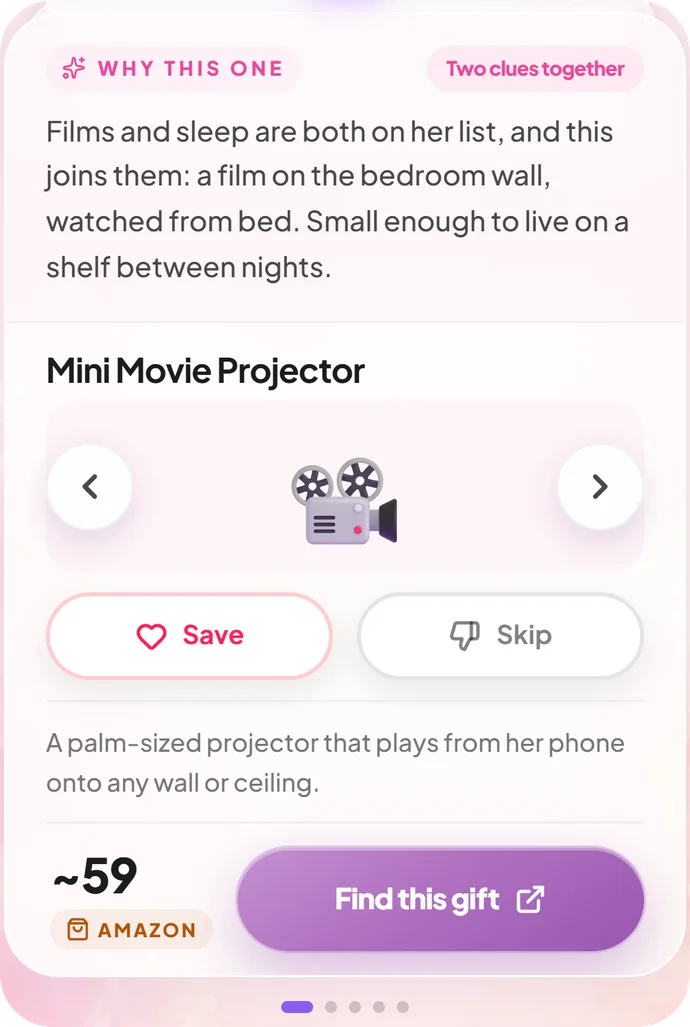
In Giftin, we entered a 26-year-old woman who likes cats, medicine, sleeping and cows. The app did not return five cow trinkets or force every interest into one item.
One suggestion was a cow-themed blanket. The cow detail supplied the personal theme; sleeping supplied the use. Other suggestions could focus on different parts of the person.
A gift does not become better because it uses every interest you listed. It needs one believable reason to fit.
Why AI gift ideas can still be generic
AI works with the information and rules it receives. “Gift for my sister” usually produces polished versions of familiar categories. More detail helps, but AI can still fail in predictable ways:
- locking onto one hobby and returning five variations
- combining unrelated interests into novelty merchandise
- renaming the same idea and presenting it as variety
- inventing prices, product details or links
- ignoring delivery time or location
Better input improves the starting point. Checks after generation keep the answer from collapsing back into repetition or impractical suggestions.
A better manual search you can use now
Write a short recipient note and search each angle separately. Keep only ideas that can finish this sentence:
I chose this for them because…
If the reason is “it appeared on a list for people their age,” you still have a product, not a decision.
How Giftin handles the same problem
Giftin remembers the person, relationship, occasion, budget, timing, past gifts and feedback you choose to add. It then looks across different kinds of ideas instead of treating the first obvious interest as the whole person.
Each suggestion includes a reason so you can reject weak logic quickly. Giftin does not replace what you know about someone. It keeps those details attached to the person and brings them back when you ask for ideas.
Quick answers
Are all gift guides useless?
No. A carefully curated guide can introduce excellent products, especially when it serves a narrow interest or situation. It becomes weak when a broad demographic label is expected to produce a personal answer.
Should I put every interest into one AI prompt?
Include relevant details, but do not demand that every result combine them. Good variety often means one idea uses a strong interest while another follows a routine, need or shared memory.
What is the fastest way to improve a bad gift search?
Add one current-life detail, one thing to avoid, one past gift and a real deadline. Those clues usually change the answer more than another age or gender label.
Sources and research notes
- A Behavioral Scientist’s Guide to Gift-Giving. Research-backed context on differences between giver and recipient priorities.
- Reddit’s Gift Ideas community. Examples of how people naturally describe recipients through routines, possessions, budgets and constraints.
- Gift. Background on gift giving as a social and relational act.
Community examples illustrate real questions and frustrations. They do not establish how common any single preference is.

Give the search a person to work with.
Giftin keeps the details you know and uses different parts of them to produce several ideas with a reason behind each one.
Download Giftin