Before you start scrolling, note what they've mentioned wanting, what they already own, anything to avoid, your budget and how soon you need it. Then look for something they'd actually use or enjoy.
You have twelve tabs open. One guide recommends a candle, another recommends a mug, and a third somehow thinks every adult needs a miniature waffle maker.
None of the ideas is terrible. That is what makes it frustrating. You know the person, but the internet only knows their age, gender or relationship to you. It can show you products. It cannot tell you which one has a real reason to belong to them.
Gift shopping gets hardest when you care because every choice feels like a small statement about how well you know someone. The way out is to stop hunting for the perfect object and make the decision smaller.
A ten-minute way to find a better gift
A thoughtful gift connects one true detail about the recipient with something they can realistically enjoy now. It does not need to summarise their entire personality.
Which details change the answer?
Collect the few clues that would make you choose differently, and stop there. You are not writing a biography.
- What do they make time for? A routine they protect is often a better clue than a hobby they mentioned once. If it is a hobby you don’t understand, see gifts for gamers, runners, photographers and more.
- What changed recently? A new home, job, pet, commute, baby, injury-free fitness goal or stressful season can create new needs.
- What have they already enjoyed? Past gifts, purchases and experiences show whether they value usefulness, sentiment, novelty or time together.
- What should be avoided? Limited space, allergies, disliked colours, difficult maintenance and “already owns a good one” can eliminate half the list.
- What does the relationship allow? A partner, sibling, coworker and distant relative call for different levels of intimacy, humour and spend.
Research has found that recipients often appreciate explicitly requested gifts more than givers expect. A wish list or direct question can show that you listened. Surprise is one way to make a gift enjoyable, not the definition of thoughtfulness.
Useful, fun or personal?
Make something they already do better
Upgrade a routine they care about. This works when you understand the category well enough not to replace a preferred item with a worse one.
Show that you remembered something specific
Use a shared memory, a comment they made or a detail that normally gets missed. Sentimental gifts can feel risky to the giver, but research suggests givers sometimes underestimate how much recipients value them.
Create time, access or an experience
A meal, class, ticket or planned day can avoid clutter and create a memory. Check the hidden work first: travel, scheduling, childcare, whether they want company and whether the booking creates an obligation.
Give a small pleasure without a permanent object
Food, flowers, coffee, skincare or hobby supplies can be personal when the selection reflects the person. “Consumable” should mean easy to enjoy, not generic filler.
Use the three-question test before buying
If an idea has a clear answer to the first two questions and no serious problem in the third, you probably have enough reason to stop searching.
A real Giftin example: the cow blanket
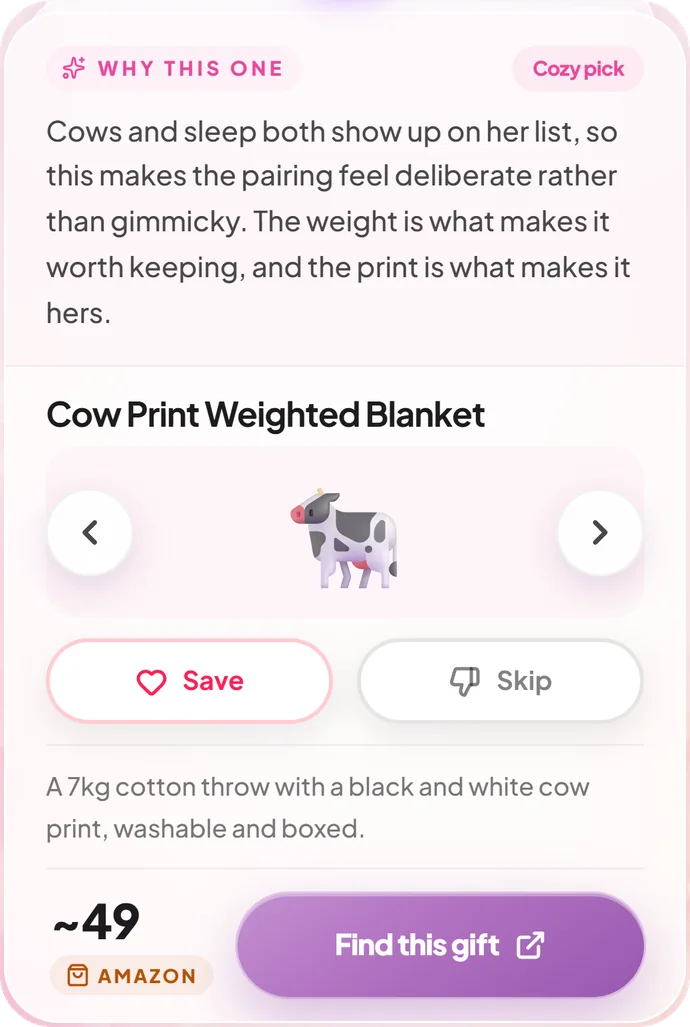
We entered a 26-year-old woman who likes cats, medicine, sleeping and cows. A weak system could lock onto the loudest interest and return five cow trinkets, or force every interest into one strange novelty product.
Giftin returned several kinds of ideas. Some used one interest. Some combined details that naturally belonged together. One suggestion was a cow-themed blanket.
- 26 years old
- likes cats and cows
- interested in medicine
- loves sleeping
The cow detail made it personal. The love of sleeping gave it a real use. Cats and medicine did not need to be printed on the same blanket for the idea to fit.
The lesson is simple: a gift can fit one meaningful part of a person. It does not need to turn their whole identity into merchandise.
What if nothing still feels right?
- Ask for a shortlist. Let them choose between three directions without making them find the exact item.
- Use a gift card with a reason. Pick a place that matches them and explain what you hope they enjoy there.
- Replace or replenish something proven. This is safer than inventing a need they never expressed.
- Plan a day out they do not have to organise. Do the booking and logistics yourself so the “gift” does not become another task.
- Choose a smaller honest gift. A good book, favourite food or handwritten note can beat an expensive object chosen under panic.
Where Giftin helps
You can do all of this with a calendar, a notes app and several searches. The annoying part is rebuilding the same picture every time an occasion comes around.
Giftin keeps the date, what the person likes, what you already gave, what fell flat and what you want to spend in one place. When you ask for ideas, it looks beyond the first obvious hobby and explains why each suggestion might fit.
It does not know the person better than you. It brings those details back before the deadline, when you still have enough time and patience to use them.
Quick answers
What do you buy for someone who already has everything?
Look for time, access, replenishment or relief rather than another permanent object: an experience they would choose, a consumable they already enjoy, help with a task, or a replacement for something worn out.
Is a gift card thoughtful?
It can be. Choose a place that reflects the recipient and add a note explaining why. A wanted gift card is more thoughtful than an impressive object they must store, return or pretend to like.
How much should a thoughtful gift cost?
Enough to fit the relationship and your finances, not enough to create pressure. Price can support the idea, but it cannot supply the reason.
What if I barely know the person?
Keep the gift modest and low-risk. Use the occasion, shared setting and any explicit preference you know. Do not fake intimacy with a highly personal gift.
Sources and research notes
- A Behavioral Scientist’s Guide to Gift-Giving. A research summary covering practical versus impressive choices and other giver-recipient mismatches.
- Give them what they want: The benefits of explicitness in gift exchange. Studies on requested gifts and recipient appreciation.
- Sentimental value and gift giving. Research on why givers can avoid sentimental gifts that recipients value.
- Gift. Background on gift giving as a social and relational practice.
The cow-blanket example is a real Giftin example. It is not a controlled study or a promise that every suggestion will be suitable.

Keep the clues before you need them.
Giftin remembers the person, the date and what happened last time, then gives you several ideas to judge.
Download Giftin