Pick one system, give one person responsibility for it and set reminders early enough to buy something. A shared calendar may be enough. As a team grows, someone still needs to keep the list current and follow through on each birthday.
Late birthday recognition can backfire
Remembering the date is only part of the job if your team has promised to mark it.
Researchers at Wharton and Tel Aviv University studied a national retail chain with 252 stores, where managers were supposed to hand out a birthday card and gift to each employee. Sometimes they were late. The paper, published in PNAS in November 2025, tracked what happened next.
In this study, recognition more than five days late was linked to poorer attendance and output.
The researchers did not find the same negative pattern when recognition arrived within five days.
Late delivery was associated with more absences and fewer hours worked in the studied retail chain.
Once the card and gift arrived, attendance returned toward normal in the study. The useful lesson for a team is simple: if you promise to mark birthdays, give someone enough notice to do it on time. For December, see Christmas gifts for coworkers.
Three ways teams do this now
Recurring events everyone can see
Free, already in the tools you own, and visible to the whole team. Weak on who acts, and goes out of date as people join and leave. Someone who left can keep triggering birthday alerts until a person notices.
One tab, owned by one person
Flexible and easy to sort, but it only works if someone opens it. When that person is on holiday, changes role or leaves, the reminders stop.
Date of birth already stored
Accurate and maintained as part of onboarding. Often not surfaced as a reminder at all, and usually locked behind permissions, so the people who would act on it cannot see it.
All three store the dates. None of them help you decide what to give someone you may not know well.
When a shared calendar is enough
A shared Google or Outlook calendar works well when all of this is true:
- The team is small enough that one person notices everything.
- That person is named, and knows it is their job.
- The recognition is the same for everyone, so there is no decision to make.
- Joiners and leavers get updated as part of onboarding and offboarding.
If that describes your team, set two alerts per person instead of one: a month before and a week before. The rest of this page is for when the team grows past that.
What goes wrong as teams grow
- The alert has no verb. “Sarah’s birthday” is information. “Order Sarah’s gift today” is a task. Notifications without a verb get dismissed.
- Nobody owns the action. When everyone can see the calendar, everyone assumes someone else is handling it.
- The lead time is too short. A same-day alert rules out anything that ships, is engraved or needs booking. That is how you end up five days late.
- There is no history. By year two, nobody remembers what was given in year one, and the same gift turns up twice.
- New joiners never get added. The birthday list is built once and maintained by nobody.
- The list has no useful notes. A date does not tell you that this person is vegan or already has three company hoodies.
A schedule that actually holds
Thirty days leaves room for shipping, personalisation and asking a colleague what the person would like. Seven days before, you can still fix a delivery that did not arrive. On the day, everything is already waiting in a drawer.
Two more rules worth writing down somewhere:
- Treat everyone the same way. The same card for everyone is fine. A thoughtful gift for some people and nothing for others feels unfair.
- Write down what you gave. Next year starts from that note, not from memory.
Consent, and the fact that this is personal data
A date of birth is personal data. In the EU that means you need a reason to hold it and a reason to share it, and “we wanted to do something nice” is not automatically enough on its own.
Beyond the legal part, some people simply do not want their age known at work, or do not want to be sung at. Ask once, during onboarding, whether they want their birthday recorded and how they would like it marked. Let no be a complete answer that nobody follows up on.
If you collect birthdays specifically for recognition, keep that list separate from the HR record, keep it to the day and month where you can, and remove people when they leave.
Where Giftin fits for a team
An office manager may know every birthday and still need help deciding what to give each person.
You are tracking more people than you can hold in your head, you want two reminders with enough lead time to actually order something, and you want last year’s gift written down next to the person instead of in a chat thread.
People, dates, reminders, notes and gift history are free, however big the team. Personalized gift ideas are the paid part, and your first 5 are free, so you can see what they look like before deciding.
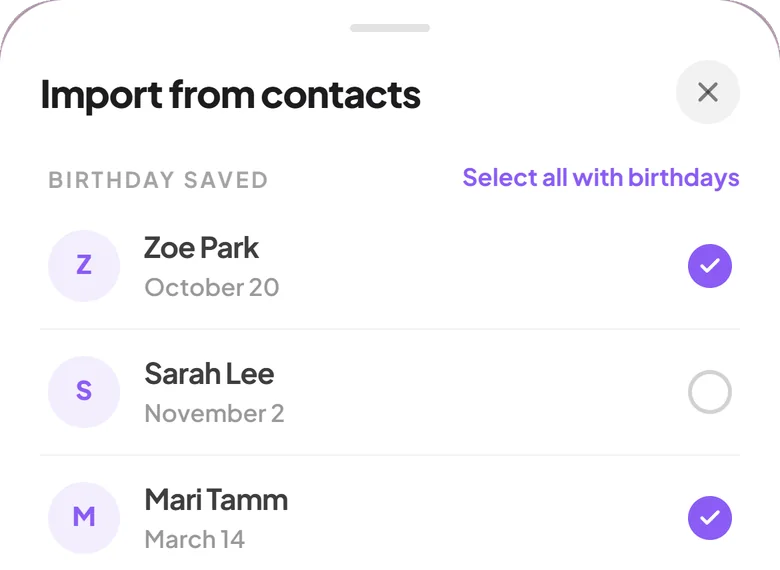
You can import people from your phone contacts. On iPhone their saved birthdays come too; on Android you pick each person and add the date. Or add people yourself. Dates, reminders, notes and gift history are free. If you are buying for a larger team and need more gift ideas than the regular plans include, email us and we will talk through the options.
Questions HR asks
How do companies keep track of employee birthdays?
Usually a shared calendar, a spreadsheet owned by one person, or a field in an HR system. The three differ less in accuracy than in what happens when the person who checks it is away.
Is it bad to wish an employee a late happy birthday?
It can matter. In one study of a retailer with an established employee birthday ritual, late recognition was associated with worse attendance and output. That does not mean the same effect will happen in every workplace.
Should we announce birthdays publicly?
Only with the person’s agreement. Ask at onboarding, record the preference, and treat a no as final.
What should a company birthday gift cost?
Keep it consistent. A small gift everybody gets usually works better than a generous one only some people get, because differences between colleagues are easy to notice.
What about work anniversaries and other occasions?
Work anniversaries can use the same reminder setup. Keep private HR dates in your HR system.
Sources and research notes
- The lower boundary of workplace mistreatment: Do small slights matter?. Hodor, Eldor and Cappelli, PNAS, November 2025. A study of a national retail chain with 252 stores, where late birthday cards and gifts were associated with worse attendance and output.
- When employees feel slighted, they work less. Knowledge at Wharton’s summary of the same study, including the five-day window and the finding that absenteeism returned to normal once the gift arrived.
One study in one retail chain, where the birthday gift was an established company ritual. The size of the effect should not be assumed to transfer to every workplace. Legal points here are general information about handling personal data, not legal advice.

Give yourself time to get it right.
Keep every person, date and reminder in Giftin for free, and write down what you gave so next year does not start from memory.
Download Giftin