Ask when the gift is expensive, technical, size-dependent or easy to get wrong. You can preserve surprise by asking for a category, three options, broad preferences or things to avoid instead of requesting one exact product.
The trick is choosing how much accuracy you need without turning the gift into a purchase order.
Six ways to ask, from accurate to surprising
You can ask very directly or barely at all, depending on how much surprise you want to keep.
Best when compatibility, size or cost decides it.
They pick the shortlist. You pick the winner.
Useful, an experience, or something for a hobby?
Ask only what they definitely do not want.
Raise it in conversation and listen properly.
Someone close to them does the asking for you.
1. Ask for the exact item
This is sensible for technical equipment, expensive purchases, clothing sizes or products with incompatible versions. Listening is not laziness.
2. Ask for three options
“Send me three things you would use. I will choose one.” The final gift stays unknown, while the chance of buying nonsense drops sharply.
3. Ask for a category
Try: “Would you rather get something useful, something to do or a complete surprise?” That can save a lot of guessing.
4. Ask what not to buy
“Anything you definitely do not want more of?” gives you freedom while ruling out clutter, duplicates and categories they dislike.
5. Float the topic without mentioning the gift
- “Are those headphones still annoying you?”
- “Would you use a massage or would that become admin?”
- “Are you still trying to avoid more stuff in the house?”
- “Would you rather do something together this year?”
6. Ask someone close to them
A partner, sibling, parent or adult child can confirm size, duplicates, the correct version and whether another person is already buying it.
When asking is clearly better
Surprise has value when the downside of guessing is small. It has less value when the wrong choice is expensive, unusable or difficult to return.
How to use an accomplice without creating chaos
- Give them one clear question. “Does she still want the black model?”
- Ask whether anyone else is buying it. Families are excellent at creating duplicates in parallel.
- Let them bring up the topic naturally. They can ask about size or preference without revealing you.
- Do not let them replace the recipient. A helper may suggest what they want the person to have.
Recruiting their partner is acceptable. Hiding in a hedge outside the electronics shop is probably too committed.
One product, three ways to ask
Highest accuracy. Little product surprise.
Good accuracy. Final choice stays hidden.
More discovery and surprise. More room for a wrong assumption.
How Giftin keeps the surprise
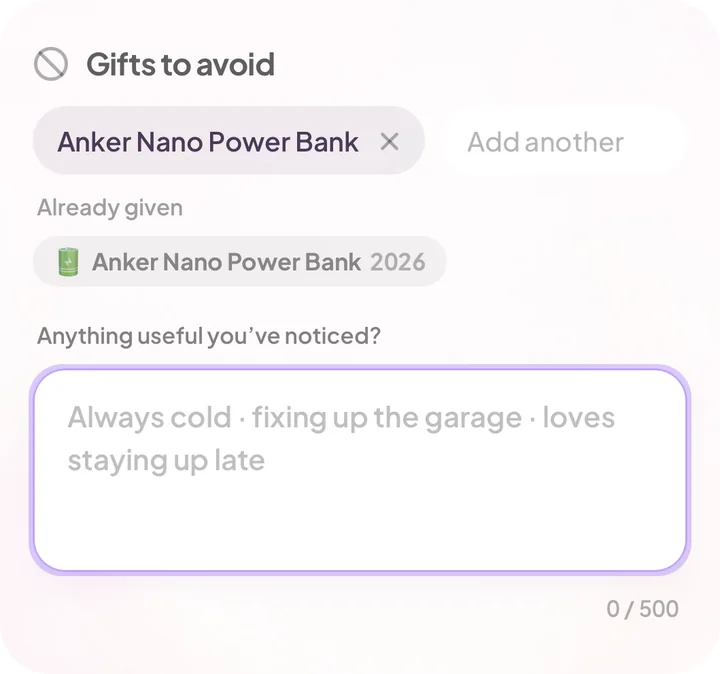
The recipient gives you boundaries: budget, category, dislikes, interests or physical-versus-experience preference.
They already chose the exact item and you do not need help with the date, past gifts or alternatives.
Giftin can explore several options inside the accepted boundaries while keeping the exact final choice as the surprise.
Still wondering?
Does asking make a gift less thoughtful?
No. Research suggests recipients often appreciate requested gifts more than givers expect. Listening is part of getting it right.
What if they say “anything”?
Offer a choice between useful, experience or surprise. It is easier to answer than a completely open question.
Should I buy exactly what they requested?
Usually, especially when the details matter. You can add surprise through presentation, a note or a small extra.
What if the request is outside my budget?
Say so, ask for alternatives or offer to contribute toward it. Do not silently buy a poor imitation.
Sources and research notes
- Give them what they want: The benefits of explicitness in gift exchange. Five studies on giver and recipient reactions to requested gifts.
- Author summary of the explicitness research. Background from one of the study authors.

Ask for the boundaries. Keep the final choice.
Giftin can use preferences, dislikes and budget to find several options without removing every bit of surprise.
Download Giftin