Build the list group by group so gaps show, confirm doubtful dates instead of guessing, and agree a simple rule for who gets an individual gift. Look ahead before crowded months and the Christmas run, keep detailed notes only for the people you actually buy for, and do a short cleanup now and then.
Remembering ten birthdays can still be a memory problem. Keeping track of 25 or 30 relatives is different.
As families grow, dates get copied wrong and several birthdays may land close to Christmas. Decide who gets a gift and what you can afford. Keep the people, dates and plans in one list you can update.
Start with the people you actually track, not the calendar
A calendar is good at showing dates. It is not good at showing who is missing. Start by deciding who belongs in your own birthday and gifting system. You are not building a family tree.
Go through the groups you naturally think in:
List the people in each group before adding their dates. You may remember every sibling but forget a niece on your partner’s side. A calendar sorted by month will not show you who is missing.
Confirm dates instead of spreading bad data
Large family lists are very good at copying mistakes. One person has June 14 in their phone. Somebody else has June 17. A third relative copies whichever turns up in the family chat first. Now the wrong date lives in five places.
If a date is doubtful, mark it unconfirmed instead of guessing. Do not guess the birth year either. For most adult birthday reminders, you do not need the year at all.
Use one list, but look at it two ways
“Is everyone here, and are the records right?” Grouping by household makes missing people and bad dates easier to spot.
“Who is next?” Sorting by what comes next makes the list useful when you need to act.
You do not need two competing lists. One record, viewed differently depending on the job. The birthday list guide covers the basic setup.
Decide what kind of acknowledgement each group normally gets
This is where a large family differs from an ordinary birthday list. With 30 people on the calendar, “buy an individual present” for every occasion may be unrealistic in money, time or both. Families handle it differently:
- gifts for children, messages or calls for adults
- individual gifts only for close family
- milestone birthdays get more planning
- one household gift instead of several adult gifts
- a family dinner instead of objects
- Secret Santa or a name draw at Christmas
- cards for everyone, gifts only where there is a tradition
Pick what makes sense for your family and budget. Then you do not have to make the same decision every time a birthday comes up.
| Group | Normal approach |
|---|---|
| Own household | Individual plan |
| Parents and siblings | Individual gift or experience |
| Nieces and nephews | Individual gift |
| Extended adults | Message or call unless it is a milestone or a gathering |
For the money side, see how much to spend on a birthday gift.
Crowded birthday months need a look-ahead, not more panic
Four birthdays in twelve days is a different problem from four birthdays across six months. The fix is to look ahead before the crowded stretch starts. One look-ahead often beats five separate reminders arriving one at a time. Ask:
- Which birthdays need an actual gift?
- Which need shipping or a booking?
- Are any of them in the same household?
- Are group celebrations already planned?
- Is a milestone coming up?
You can place several orders in one sitting without making the gifts identical. The efficiency comes from doing the admin together, not from treating people the same.
Christmas and birthdays can collide
A birthday in late November or December competes with Christmas for the same time and budget. The answer is not to merge the birthday into Christmas, unless that is genuinely what the person wants. Plan the season as a workload instead. If December holds three birthdays, an anniversary and Christmas gifts for twelve people, December-you already has too much to decide from scratch.
Start those decisions earlier, simplify where the relationship allows it, and set one budget across the whole period instead of treating every gift as an isolated purchase. This matters most for children, where a birthday and Christmas can both mean presents within a few weeks. The Christmas gift list template and Christmas budget guide help with the second half.
Family records go stale faster than you think
Families change all the time. A new baby, a new partner, children growing out of age-specific interests, a relative moving abroad, a hobby started or dropped, changed traditions, new expectations once people move out or have children.
That calls for a light review, not constant maintenance. Every so often, ask:
- Who joined the family?
- Which dates are still uncertain?
- Which notes are obviously stale?
- Who do we no longer buy for individually?
A five-minute cleanup beats trusting a ten-year-old list forever.
Keep less information as the family gets bigger
It sounds backwards, but it matters. A 30-person system should not hold 30 detailed gift profiles unless you truly need them. Use richer context only for the people you actively buy for.
Name + birthday + relationship + reminder
Current interest + a note from her parents + last year’s gift
For your partner, you may keep much more. The bigger the family, the more selective the notes should be. That keeps the list easy to update.
Do not solve a family problem with duplicate lists
A shared spreadsheet, a calendar and individual reminder apps can all work. The risk is everyone keeping their own version and nobody knowing which date is right. If the family genuinely wants a shared list, decide who can edit it, who confirms corrections, what happens when dates conflict, and which copy is the one everyone updates.
If the list is only for you, keep it private and simple.
Where Giftin fits
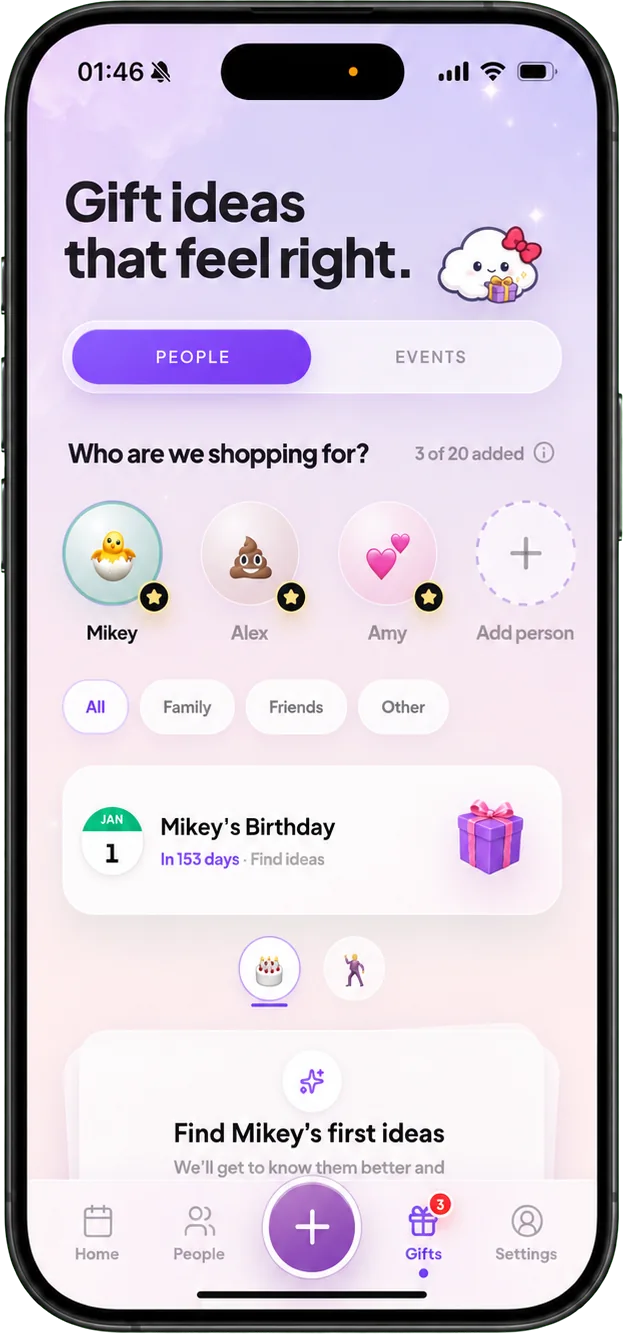
Giftin keeps people, important dates, interests and notes, saved ideas and past gifts together, with reminders before each occasion. For a big family, the useful part is keeping rich context for the few people you buy for often, while everyone else stays a simple date record.
Giftin works as your own private list. It does not need to become the whole family’s shared directory.

Every birthday in the family, without the spreadsheet.
Giftin keeps simple date records for everyone and deeper notes for the people you actually buy for.
Download Giftin