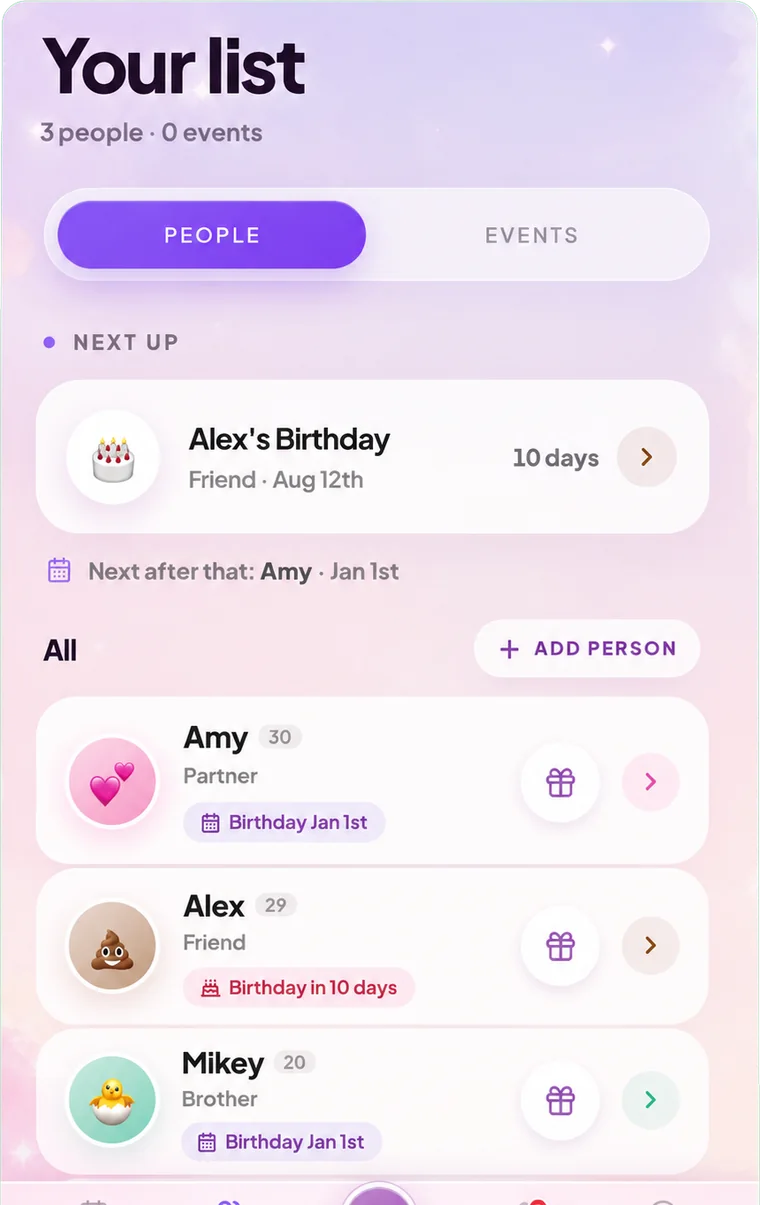
Start with name and birthday, kept in one place you trust. Add a field only when it answers a question you really have: relationship, how early you need to act, and this year’s idea or status. Keep one master list for corrections and look at it sorted by what is coming up next.
At minimum, a birthday list is name plus birthday. That alone stops you relying on memory. But if your real problem is “I remember the date and still end up unprepared,” the list can do a little more without turning into a big spreadsheet.
Start with the smallest useful birthday list
You do not need a huge spreadsheet to stop forgetting birthdays. Start here:
| Name | Birthday |
|---|---|
| Mum | May 12 |
| Alex | June 3 |
| Mia | June 18 |
That already solves one problem: the date has a reliable home. Only add another field when it answers a question you genuinely have.
Add planning fields only when they help you act
Add a column when it helps you remember a date or make a plan.
| Person | Birthday | Context | Plan by | This year |
|---|---|---|---|---|
| Mum | May 12 | Close family | Earlier | Restaurant idea |
| Alex | June 3 | Friend | Normal | No gift planned |
| Mia | June 18 | Niece | Earlier | Ask parents |
Relationship or context
Useful when the list mixes family, friends, colleagues and children and you do not treat every birthday the same. “Alex, June 3” is ambiguous if you know three Alexes. “Alex, university friend” is enough.
Planning lead
No exact number needed. Early, normal, or day-of message only. It separates your partner’s birthday weekend from the colleague you message on the day. How early to start depends on the kind of gift.
Current idea or status
Keep it very short: no idea, ask sister, book restaurant, ordered, done. A birthday list becomes a planning list when it shows not only who is next, but who still needs something from you.
Do you need the birth year?
Often, no. Month and day are enough for an adult whose age does not change what you plan. The year is more useful for children, milestone birthdays, age-specific events, or any time you genuinely need to know the age they are turning.
Do not collect extra personal data because a template has a field for it. If you know the year and use it, save it. If not, “unknown” beats a guess.
Build the list from information you actually trust
Good sources: your phone contacts, calendars you already use, old messages, invitations, the person themselves, or a family member who actually knows.
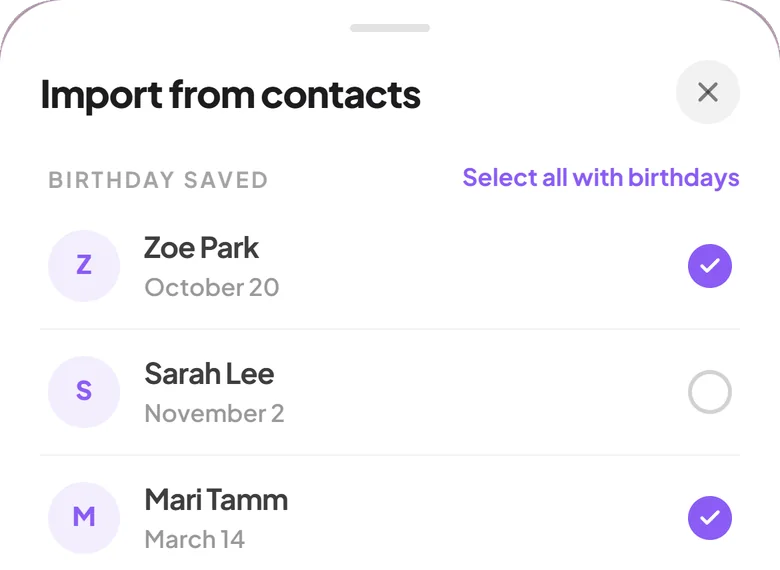
If the dates already live in your phone contacts, Giftin can import them. On iPhone, contacts with a saved birthday are listed first and come in with their dates. On Android, you pick people one at a time and add the birthday.
If two dates conflict, do not pick the one that looks more plausible. Mark it uncertain and confirm it. That sounds fussy until one wrong birthday gets copied into several calendars and stays wrong for five years.
Keep one master list, then use an upcoming view
- adding people
- correcting dates
- checking who is missing
- scanning the whole year
- what is happening next
- what needs planning
- who still has no idea or status
Forty birthdays sorted January to December get harder to use as the year goes on. The action view should start from today, not January 1. Whatever you use, make the everyday view a countdown of what is coming up, and keep the full-year list for maintenance.
A list and a reminder do different jobs
The list stores the date. The reminder tells you when to act.
They can be the same tool, but do not have to be. Contacts can hold the birthday, Calendar can show it, a reminder can tell you when to plan and a person note can keep a gift clue. The only danger is maintaining several competing copies by hand. Decide where the birthday is authoritative, then make the reminders serve it. For the reminder side, see iPhone or Android.
Do not make every birthday equally complicated
If your list has 30 people, a full gift-planning record for all 30 will go stale. Use richer planning only where it helps.
Name + date + reminder
Name + date + planning lead + current idea
The list should reflect your actual relationships, not pretend every birthday needs the same process. For a big family, this gets its own guide.
Copyable birthday-list templates
- Name:
- Birthday:
- Name:
- Birthday:
- Relationship or context:
- How early do I need to act?
- This year’s note or idea:
- Status:
The minimal version is enough if remembering is the whole problem. Keep deeper gift profile details somewhere else unless they are useful here, so the list stays scannable.
Review the list occasionally, not constantly
Now and then, check for new people to add, duplicate records, uncertain dates you can now confirm, people you no longer need to track, and reminders that keep arriving too late.
You do not need a weekly birthday-admin ritual. The system is working when you mostly forget about it until it gives you useful notice.
Where Giftin fits
Giftin lets you add people and important dates, set reminders, and keep notes, saved ideas and past gifts with each person. The list can grow into planning where you need it, without forcing every person into a complicated record.

Your birthday list, with a heads-up built in.
Add people and dates in Giftin, and get reminded early enough to actually plan.
Download Giftin